
The below incident highlights just how easy it is for DATA criminals to penetrate the mail room of Australia’s largest communications carrier. In order to intercept information from me pertaining to their activities within the carriers national communications grid network . Indicating just how efficient SYSTEM INTEGRATED GANGSTAKING can be!
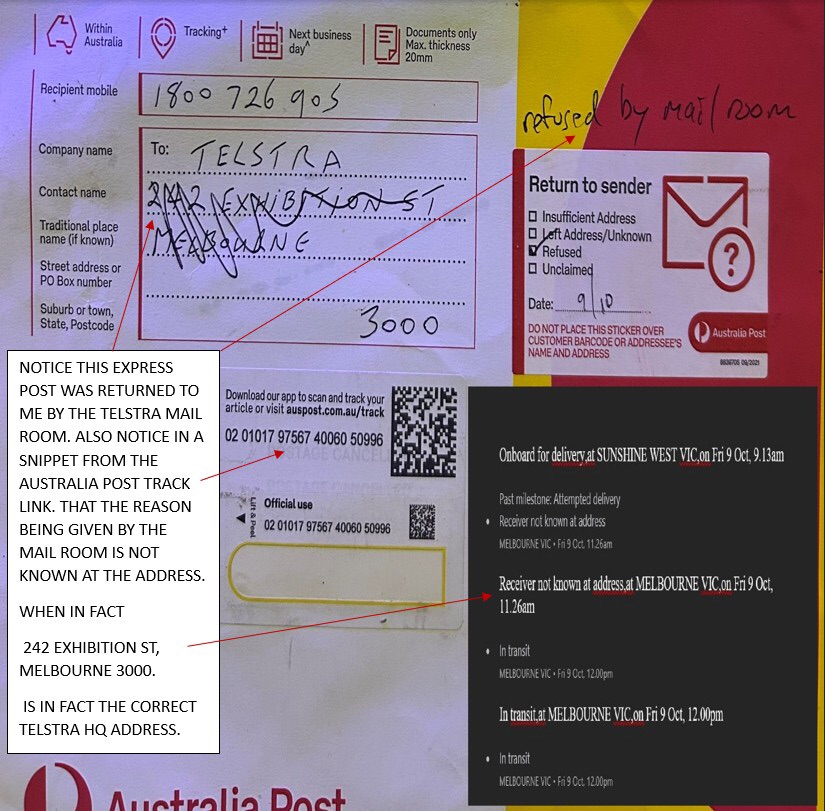
I believe they were able to achieve the interception of my information by combining three levels of their control and surveillance systems together.
The first being able to identify my intentions by observing my searches on my smart devices and even capturing my documents if I make a mistake and don’t clear all caches before hotspotting to the internet. They may also have access to the cloud and my email passwords by again being able to see my smart device interfaces as I don’t save passwords on my smart devices.
Secondly being able to track my movements from the moment I switch off my lights to leave my property as this would immediately appear on their server from my captured smart meter. This can then be confirmed by CCTV on my property to then being tracked via the intersection cameras and even peoples home CCTV and ring cameras as many people do not change their passwords after the unit has been installed and unsupervised public surveillance operators would have access to video from these cameras if needed. This tracking can then be taken over by CCTV on public transport again by public surveillance operators as I don’t have a vehicle.
Lastly GEO fencing would be incorporated to identify immediate phones around me or by position ( focusing in this case on who are in the Bentleigh Australia post office and Exhibition st Telstra mail room workers). Who are then alerted of my “dangerous” existence to their proximity. This character assassination narrative would be delivered via the data criminals already established social media pages to those workers social media messages/text app and would be tailored around that persons gender,race, sexuality, sensitivities for best impact and then hopefully incorporation into participating in illegal activities on behalf of the data criminals.
Unfortunately, important communication organisations like Australia post and Telstra are still not aware to the level of sophistication these data criminals have penetrated the hub of the national grid and in turn every entity and individual if they so choose as in evidenced in this case. Our internet convenience would have also become the criminal’s convenience as well.
Australia post front desk Worker/s and or maybe the Australia post delivery driver would have been contacted via their phone to get the envelopes delivery destination and tracking number.
Then the worker/s in the mail room at Telstra HQ who would also have their smart phones on their person would then be contacted via the same method as the Australia post staff had been. Informed of envelopes movements as would have been tracked via its tracking number. Once the post had arrived a worker/s would then be looking amongst the mail for my name and address as sender.
Then as we see on the envelope. The envelope was returned to me stating NOT AT THIS ADDRESS when it was clearly sent to the correct address.
If you would like to inform Telstra about this incident. Contact them on 1800726905
CRIMES COMMITTED BY THE DATA ELECTRICIANS/OWNERS
I imputed into chatGPT the actions taken against me and these are the results below according to Australian state and federal law.
WHAT CRIME IS COMMITTED WHEN AN INDIVIDUAL COMPANY USES THEIR POSITION IN DATA INSTALL/ TELECOMMUNICATIONS TO CAPTURE AND DISTRIBUTE PRIVATE IMAGES TO BLACKMAIL
ChatGPT said:
In Australia, if a person working in data installation/telecommunications abuses their position to capture and distribute private images for blackmail, several serious criminal offences may apply under both Commonwealth law and State/Territory law.
Here are the main ones:
1. Blackmail / Extortion
- Criminal Code Act 1995 (Cth), s 134.2 – “Obtaining a gain, causing a loss, or influencing conduct by threat.”
- State/Territory equivalents (e.g. Crimes Act 1958 (Vic), s 87 – blackmail).
➡ Maximum penalty: up to 14 years imprisonment (varies by jurisdiction).
2. Image-Based Abuse (“Revenge Porn” laws)
- Capturing or distributing intimate/private images without consent is a criminal offence.
- Example: Crimes Act 1958 (Vic), ss 41DA–41DB.
➡ Penalties: up to 3 years imprisonment (distribution) and 2 years (threats to distribute).
3. Unauthorised Interception / Access to Communications
- Telecommunications (Interception and Access) Act 1979 (Cth) makes it an offence to intercept or access private communications without lawful authority.
➡ Penalty: up to 10 years imprisonment.
4. Computer/Telecommunications Offences
- Criminal Code Act 1995 (Cth), Part 10.7 – offences relating to misuse of telecommunications services (e.g. using a carriage service to menace, harass, or offend).
➡ Penalty: up to 3 years imprisonment (or more if aggravated).
5. Privacy / Surveillance Device Offences
- Surveillance Devices Acts in each state prohibit using equipment to record people without consent.
➡ Penalty: usually 2–5 years imprisonment depending on state.
WHAT CRIME IS COMMITTED WHEN AN INDIVIDUAL DISGUISES THEMSELVES AS STAFF AT A POOL IN ORDER TO CAPTURE NUDE IMAGES OF A TARGETTED INDIVIDUAL AND THEN DISTRIBUTES THESE IMAGES TO DESTROY REPUTATION, NETWORKS AND BUSINESS.
ChatGPT said:
Short answer: several criminal offences may have been committed — most likely voyeurism/secret recording, distribution of intimate images without consent (image-based abuse / “revenge porn”), plus possible stalking/harassment, blackmail/extortion (if threats or demands were made), and impersonation/fraud or trespass depending on how the person got access. Which exact offences apply (and which agency prosecutes them) depends on the state/territory where it happened and on the precise facts, but all of the actions you described are taken very seriously by Australian police and regulators. Melbourne Criminal Defence Lawyers+2Doogue + George+2
What offences to consider (common examples)
- Voyeurism / secret recording — covertly photographing or filming someone in a private/partially private setting (naked, showering, changing) is a criminal offence in many states. For example, Victoria criminalises visually capturing another person’s genital or anal region without consent. Melbourne Criminal Defence Lawyers
- Distribution of intimate images without consent (image-based abuse / non-consensual sharing) — passing on or publishing intimate images of someone without their consent is a specific offence in most Australian jurisdictions and at the federal level there are enforcement tools and laws to remove and penalise such material. Penalties can include fines and imprisonment. Doogue + George+1
- Stalking, intimidation, harassment, coercive control — repeatedly targeting someone to destroy reputation, networks or business can attract stalking, intimidation or coercive behaviour offences (again varying by state). Cases often combine image offences with stalking charges. The Daily Telegraph
- Blackmail / extortion — if the perpetrator threatened to publish images to coerce the victim (e.g. demand money, force, or other conduct), that can be an offence of blackmail/extortion. Women’s Legal Service NSW
- Impersonation / fraud / trespass — disguising yourself as staff to gain access could amount to fraud, impersonation (particularly if pretending to be an official) or trespass/unauthorised entry — all criminal in particular circumstances. ShunCulture+1
- Technology-facilitated offences — using devices, online services or a carriage service to distribute images can bring additional offences under federal law. The Commonwealth and state governments have policy/principles and new measures addressing such tech-facilitated abuse. Attorney-General’s Department+1
WHAT CRIME IS COMMITTED WHEN AN INDIVIDUAL KNOWINGLY PARTICIPATES IN HARRASMENT, GANG STALKING, DEFAMATION, BLACKMAIL OF AN INDIVIDUAL BASED ON PRIVATE IMAGES DATA ILLIGALLY OBTAINED.
ChatGPT said:
In Australia, if an individual knowingly participates in harassment, gang stalking, defamation, and blackmail of someone based on illegally obtained private images, several serious crimes may apply. Depending on the state/territory and exact conduct, the following offences are relevant:
1. Image-Based Abuse / Distribution of Intimate Images
- Under Criminal Code Act 1995 (Cth) and state laws (e.g. Crimes Act 1958 (Vic) s41DA), distributing or threatening to distribute private sexual images without consent is a criminal offence.
- Maximum penalties can range up to 7 years imprisonment.
2. Blackmail / Extortion
- Using private images to pressure, threaten, or control someone (e.g. to damage their reputation, gain advantage, or force compliance) is blackmail, which is a very serious indictable offence.
- E.g. Crimes Act 1958 (Vic) s87 – Blackmail carries up to 15 years imprisonment.
WHAT CRIME IS COMMITTED WHEN AN INDIVIDUAL KNOWINGLY PARTICIPATES IN HARRASMENT, GANG STALKING, DEFAMATION, BLACKMAIL OF AN INDIVIDUAL BASED ON A COORDINATED ONLINE CAMPAIGN.
ChatGPT said:
In Australia, if a person knowingly participates in a coordinated online campaign that involves harassment, gang stalking, defamation, or blackmail, several serious criminal and civil offences may apply, depending on their actions and intent. These can include:
🔹 Criminal Offences
- Stalking / Cyberstalking
- Crimes Act 1958 (Vic) s21A and similar provisions in other states.
- Covers repeated harassment, intimidation, surveillance, or online pursuit designed to cause fear, distress, or harm.
- Using a Carriage Service to Harass, Threaten, or Menace
- Criminal Code Act 1995 (Cth), ss 474.15–474.17.
- Makes it an offence to use the internet, email, or social media to menace, harass, or cause offence.
- Blackmail / Extortion
- Crimes Act 1958 (Vic) s87 or equivalent laws nationally.
- Threatening to reveal information (such as private images) to obtain benefit, compliance, or to cause harm.
- Criminal Defamation
- Crimes Act 1900 (NSW) s529 and similar in some jurisdictions.
- Publishing false material knowing it will harm someone’s reputation.
- Conspiracy / Joint Criminal Enterprise
- Criminal Code (Cth) and state equivalents.
- If people act together in a planned campaign to harass, stalk, or blackmail, all participants can be guilty—even if they did not perform every act themselves.
- Unlawful Threats / Intimidation
- Threatening physical, emotional, financial, or reputational harm can also constitute a criminal offence.
🔹 Civil Wrongdoing
Alongside criminal liability, victims may also sue participants for:
- Defamation (civil action for reputational harm).
- Intentional infliction of emotional distress.
- Invasion of privacy (limited but developing in Australia).

